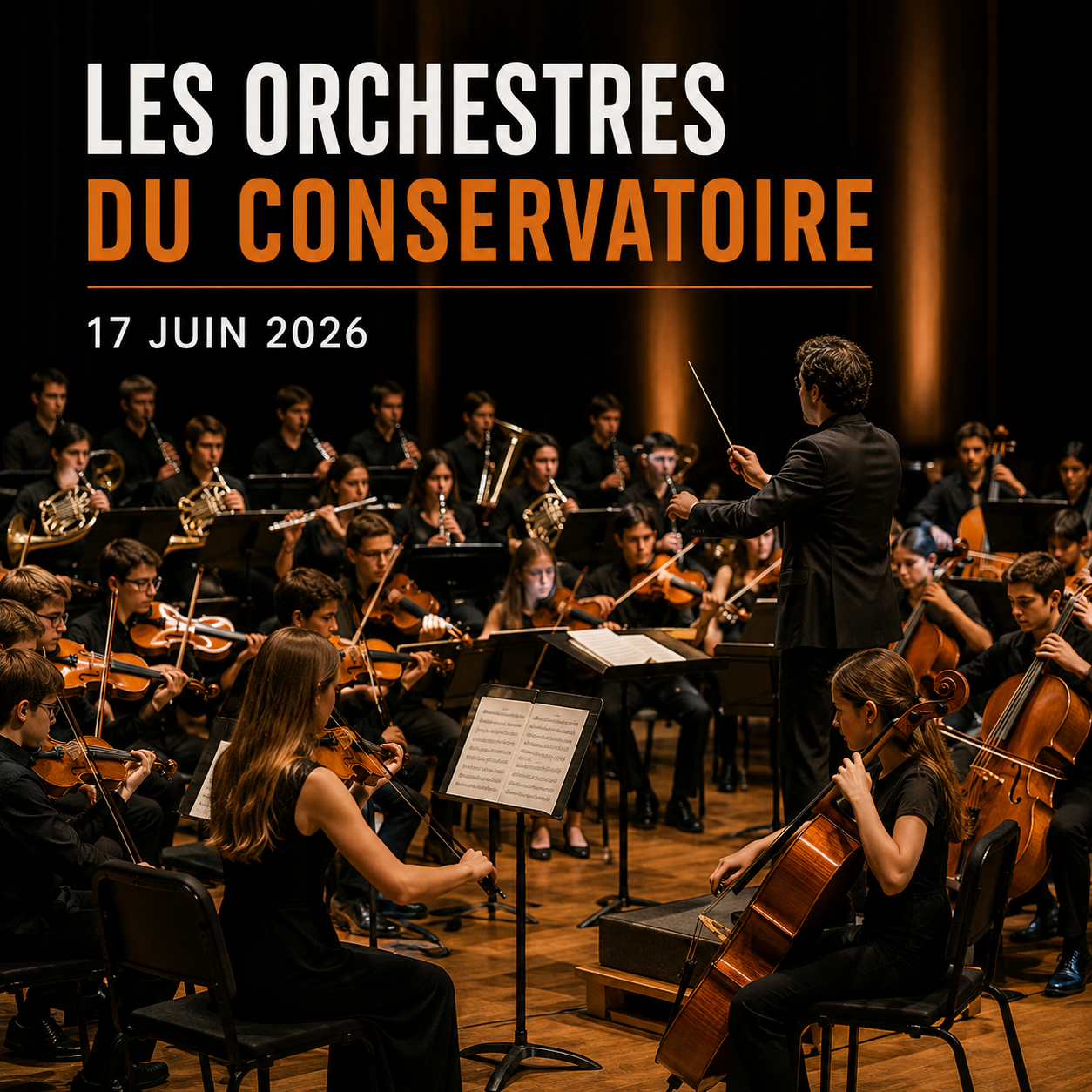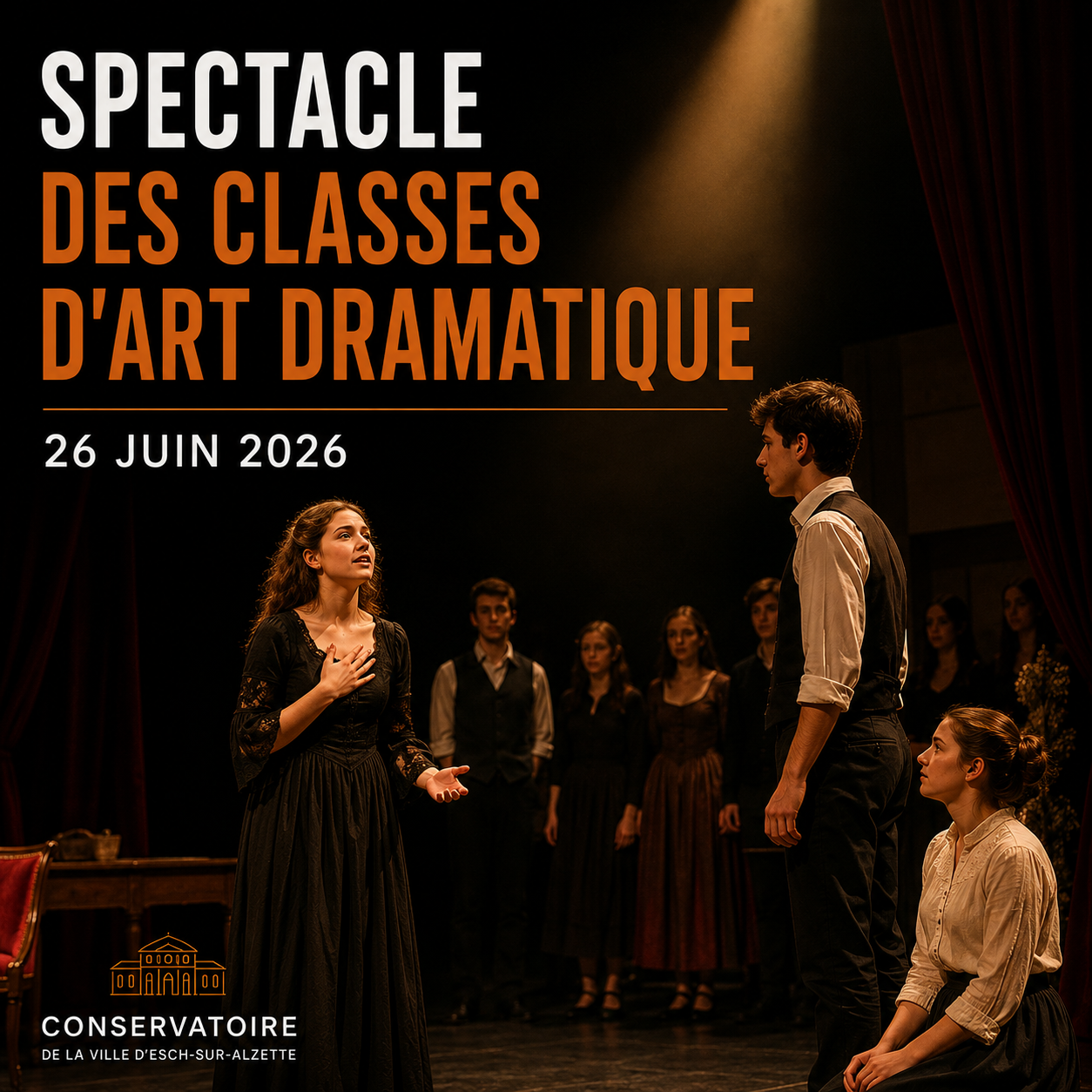
Spectacle des classes d'art dramatique du Conservatoire
22 May 2026

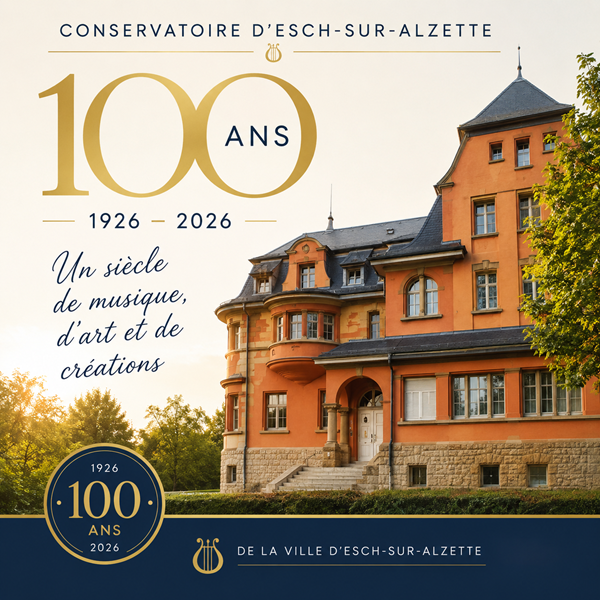
100 Years of the Conservatoire of Esch-sur-Alzette: A Century Dedicated to Music and the Arts
Esch-sur-Alzette, 2026 — In 2026, the Music Conservatoire of the City of Esch-sur-Alzette celebrates an exceptional anniversary: one hundred years of existence at the heart of the Grand Duchy of Luxembourg's second largest city. Officially founded on 13 August 1926, the institution has for a century been an essential pillar of artistic education and cultural life in Esch. A look back at a century of history, music and transmission.
The idea of a music school in Esch-sur-Alzette is far older than 1926. It was born in a context of unprecedented economic and demographic growth: with the opening of the iron mines around 1850 and the construction of the first steelworks, Esch transformed into a working-class city. Within a few decades, the population grew from 2,123 inhabitants in 1869 to more than 25,000 at the beginning of the 20th century. This growth was accompanied by a flourishing cultural and associative life: choirs, brass bands and symphonic circles multiplied — the "Uelzecht" choir (1895), the Harmonie (1906), and the Symphonic Circle (1902), to name but a few.
In December 1913, two Esch associations — the "Uelzecht" choir and the Symphonic Circle — presented the municipal council with a petition bearing 287 signatures in favour of creating a music school. The First World War halted all progress. It was not until May 1917 that the municipal council commissioned a study from Charles Günther, director of the Municipal Harmonie. On 14 July 1917, the town council gave its agreement in principle to create a music school "for the children of workers, craftsmen and employees."
The road remained difficult: the government agreed in principle to cover 40% of operating costs, but the 1919 bill was blocked by the Council of State. In January 1920, the Council acknowledged the merits of a music school in Esch, but opposed the use of the term "conservatoire," deeming the programme too ambitious and the requested subsidies excessive. Parliamentary debates followed, involving several members of parliament.
It was finally in August 1923 that the "École de Musique" cooperative was established, laying the foundations of the institution.
On 13 August 1926, the municipal administration of Esch-sur-Alzette took over the establishment and gave it the name "École municipale de Musique" (Municipal Music School). This marks the official birth of what would become the Music Conservatoire of the City of Esch-sur-Alzette. The institution moved into a school building on rue de l'Église, where it would remain for the following seventy years.
From the very first season of 1926–1927, a tradition took root: the Conservatoire offered three concerts by the orchestra and choir, made up of students and teachers. The institution's dual educational and public vocation was established from the outset.
From the 1930s onwards, concerts extended beyond the local framework. Internationally renowned soloists and ensembles performed regularly in Esch-sur-Alzette. The Conservatoire established itself as a genuine cultural hub, radiating well beyond the city's borders.
Like all cultural institutions in Luxembourg, the Conservatoire endured the turmoil of the Second World War and the years of occupation. The history of cultural resistance in Esch during this period remains etched in collective memory. After the war, the institution rebuilt on new foundations and gradually gained recognition beyond national borders, notably through its symphony orchestra.
Over the decades, the educational offering expanded considerably. The Conservatoire broadened its range of disciplines, moving from classical music alone to a much wider spectrum including jazz, dance and dramatic arts. The institution's regional influence grew, attracting students not only from Esch-sur-Alzette, but from across the Minett region and neighbouring countries.
The Conservatoire gradually built up numerous ensembles linking theoretical teaching with musical practice: harmony orchestra, brass band, chamber ensembles and instrumental orchestras. These groups serve both as educational tools and as vehicles for cultural outreach.
In 1993, the "Concerts du Conservatoire" cycle was launched, marking a new stage in the institution's development. This regular programme — featuring classical and jazz concerts — runs each season from October to May, and features nationally and internationally renowned artists and groups. This cycle has cemented the Conservatoire's place as a major cultural player in the region.
After seventy years on rue de l'Église, the Conservatoire moved to its current premises at 50, rue d'Audun / avenue des Terres Rouges (L-4018 Esch-sur-Alzette). This modern building provides the infrastructure suited to its development: classrooms, an auditorium, and spaces dedicated to the various artistic disciplines.
The Conservatoire of Esch-sur-Alzette today offers a wide range of courses, accessible from the age of 7 through to adulthood, ranging from beginner classes to training that opens the door to a professional artistic career. These include:
Music (classical and jazz): piano, organ, harpsichord, accordion, guitar, string instruments, wind instruments, percussion, music theory, composition, conducting, chamber music, classical singing, rock/pop and musical theatre singing.
Dance: classical ballet and other disciplines.
Speech Arts: diction and dramatic arts (the latter being accessible after adequate diction training).
Certain disciplines — singing, diction, dramatic arts and dance — require aptitude tests. Since the 2022–2023 academic year, a large proportion of music, speech arts and dance courses are free of charge for minor students under the national policy on free municipal music education, up to the first cycle diploma. Registration fees of €100 to €150 apply in cases not covered by this policy or for adult students.
Since 2010, the Rotary Club Esch-sur-Alzette has annually rewarded outstanding Conservatoire students through the Music Prize, established to mark the club's 50th anniversary celebrations. This prize has become a fixture in the Conservatoire's calendar. Winners have the opportunity to perform as part of the institution's concert season. For the 2025 edition, the laureates were Lara Lemos (classical dance), Magali Lopez Verruno (diction) and Charel Breisch (organ).
Since 2022, the Conservatoire has been led by Jean Halsdorf, with Jean-Claude Thilges serving as Deputy Director.
The year 2026 is dedicated to the centenary. The celebrations were officially launched on 10 January 2026 with an opening evening held in the Conservatoire's auditorium, in the presence of Mr Eric Thill, Minister of Culture, Mr Christian Weis, Mayor of the City of Esch, and Mr Pierre-Marc Knaff, alderman. Teachers, students and the public attended a varied artistic programme showcasing the diversity of the institution's disciplines, followed by a convivial reception.
Throughout the year, the Conservatoire offers a range of cultural events open to the general public, details of which are available on its official website (conservatoire.esch.lu/concerts).
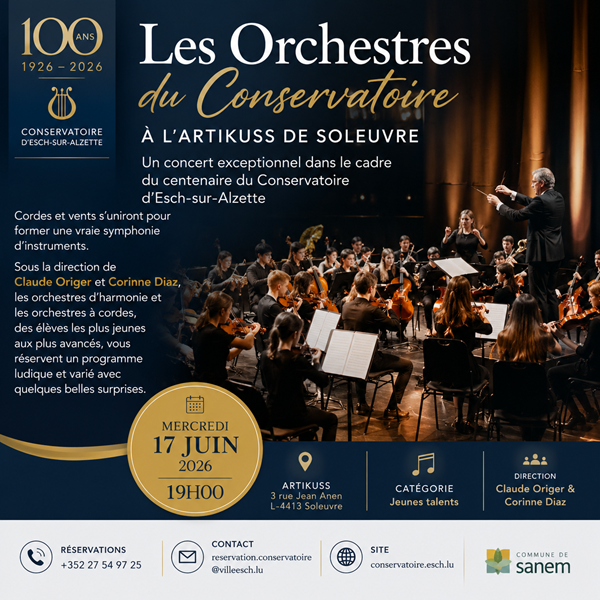
The highlight of this centenary comes at the Francofolies d'Esch/Alzette 2026, taking place from 12 to 14 June at the Parc du Gaalgebierg. As part of this festival, the French duo Terrenoire — revelation of the 2022 Victoires de la Musique — will perform on Saturday 13 June on the Escher Theater stage alongside the Harmony Orchestra of the Conservatoire of Esch-sur-Alzette, in a unique creation dedicated to the institution's 100th anniversary. An event that perfectly embodies the Conservatoire's mission: building bridges between the transmission of musical heritage and contemporary creation.
Over one hundred years, the Conservatoire of Esch-sur-Alzette has accompanied the great transformations of a city that has journeyed from a mining and industrial town to a European Capital of Culture (2022). It has shaped generations of musicians, dancers, performers and music lovers, contributing to making Esch-sur-Alzette a recognised cultural hub across the Greater Region.
From the small cooperative of 1923 to the multidisciplinary institution of today, the journey has been remarkable. The Conservatoire remains, in 2026, faithful to its original mission: making music and the arts accessible to all — from the children of working-class neighbourhoods to discerning amateurs, from beginners to aspiring professional artists.
Sources: Official website of the Music Conservatoire of the City of Esch-sur-Alzette (conservatoire.esch.lu), Esch municipal administration (administration.esch.lu), Visit Luxembourg, Esch Citylife, Francofolies Esch/Alzette, Moustique.
22 May 2026